I'm Not an AI Engineer.
I'm an Agentic Engineer.
Why the future of business isn't about using AI. It's about building systems where AI executes.

Everyone's sharing roadmaps to become an "AI engineer."
Learn Python. Take Karpathy's course. Build a RAG app. Deploy on Hugging Face. Done. You're an AI engineer.
But here's what nobody's explaining: the biggest opportunity in AI right now isn't in building models. It isn't in fine-tuning. It isn't in building chatbot wrappers.
It's in building businesses where AI is the execution layer.
I didn't learn transformers so I could build a transformer. I learned enough to understand what the model can do, what it can't do, and how to build systems around it that turn capability into output. Consistently. Reliably. In production. For real clients with real money on the line.
That's agentic engineering. And it's a fundamentally different skill set than what most people are learning.
The Difference
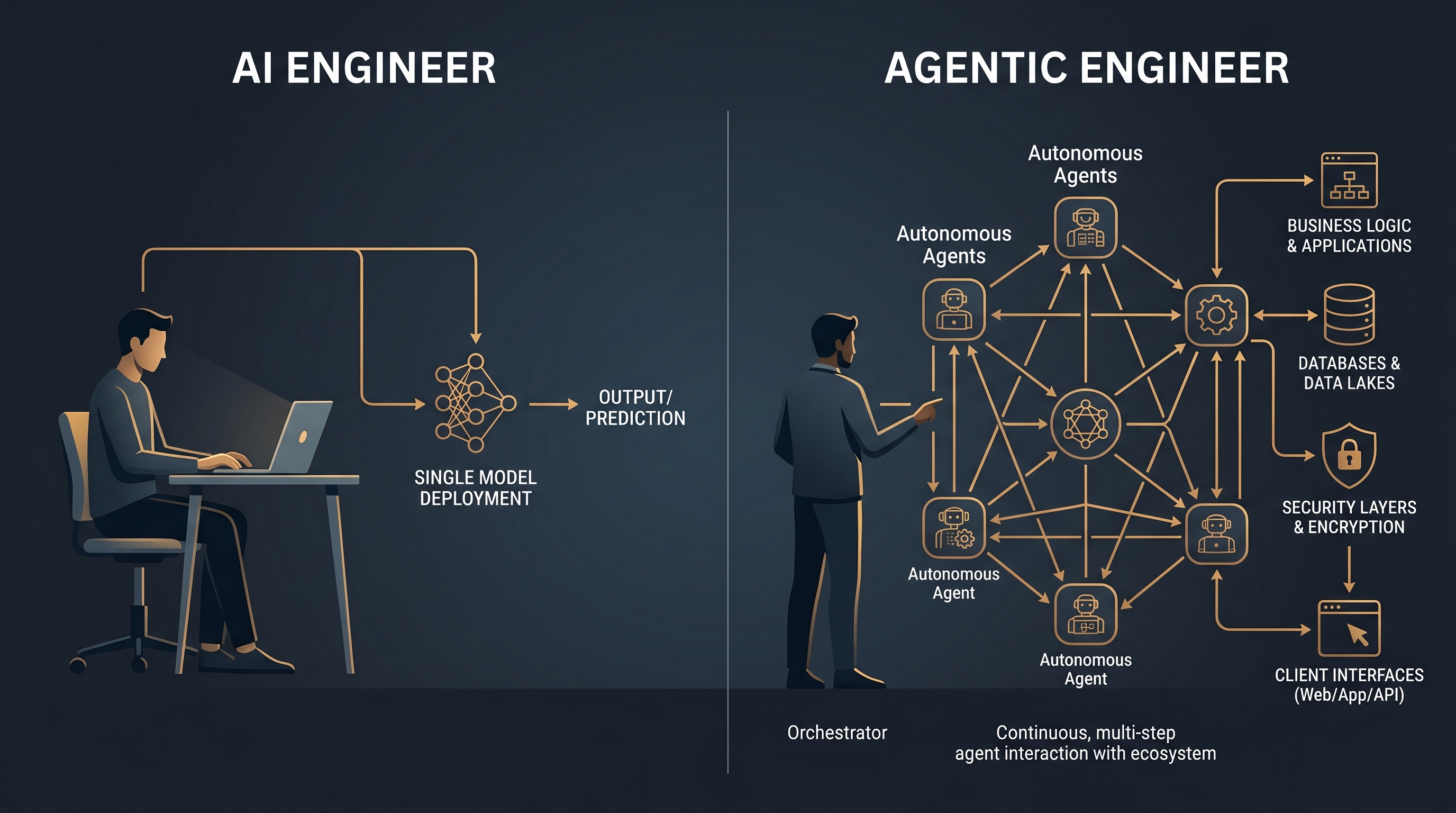
| Dimension | AI Engineer | Agentic Engineer |
|---|---|---|
| Core Question | How do I make this model perform better? | How do I make this model produce consistent, trustworthy output inside a business process? |
| Environment | Notebooks, Kaggle, benchmarks | Production systems with paying clients, compliance, and security constraints |
| Failure Mode | Lower accuracy score | Malpractice, federal violations, lost client trust |
| Memory | Context window within a session | Durable external memory that persists across days and weeks |
| Definition of Done | Benchmark metric improves | Observable behavior meets spec, nothing breaks, proof is external |
| Scope | Model performance | End-to-end business system |
| Risk Tolerance | Hallucination is an inconvenience | Hallucination is a liability |
An AI engineer asks: "How do I make this model perform better on this benchmark?"
An agentic engineer asks: "How do I make this model produce consistent, trustworthy output inside a business process where mistakes cost real money and real trust?"
The first question lives in notebooks and Kaggle. The second lives in production systems with paying clients, compliance requirements, and security constraints.
When a trust document has the wrong beneficiary name, that's not a hallucination. That's a malpractice issue. When a client's financial data leaks, that's not a model safety problem. That's a federal violation.
The stakes are different. So the engineering has to be different.
What We Actually Built
People ask what our "AI strategy" is. The question misses the point. We don't have an AI strategy. We have a business strategy that happens to be executable because of AI.
Client Onboarding Portal
Intake forms, auto-lead creation, OSINT enrichment (Apollo, Sherlock, GhostTrack), routing. Built in a week. Live and collecting leads.
Estate Planning System
Three trusts for a physician client. Tracks 5 blocking items before execution. Coordinates with reviewing attorney. Plain-language client briefings.
Construction Compliance System
Maps every Florida permit, inspection, and structural test. Defines who holds what document, when, and what happens when they don't.
Overnight Agents
Research competitors, monitor market shifts, maintain a knowledge vault, deliver morning briefings. Not reminders. Autonomous workers producing real intel.
None of these are demos. They're all in production. They all have real users. They all generate revenue.
The Architecture Nobody Talks About
The roadmap articles skip the hard parts. Here's what actually makes agentic systems work:
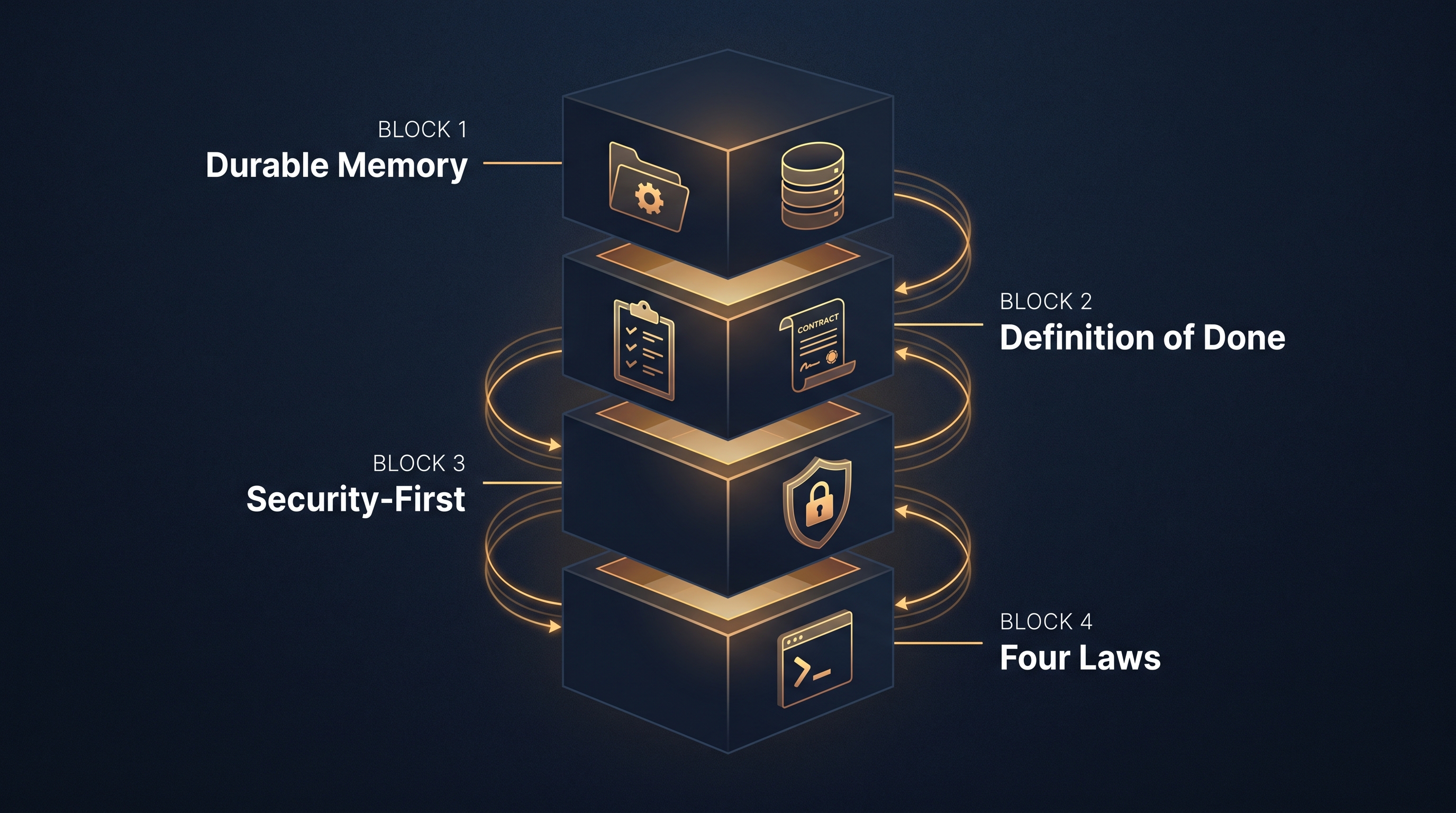
01 Durable External Memory
The model can't remember anything. Not between conversations. Not between sessions. Not between days.
The "agentic" part isn't the model. It's the system you build around the model that gives it continuity. We use curated memory files: long-term memory, daily logs, task state, and a knowledge vault. Every time the agent starts, it reads these files and reconstructs context from scratch.
Research published this week confirms it: long conversation histories actively degrade agent performance. The models get pulled toward past interactions instead of future goals. Curated external state outperforms raw context dumps. Every time.
The source of truth stays outside the conversation.
02 Definition of Done
Most people give agents vibes: "improve the dashboard," "make onboarding smoother." Agents interpret vibes by optimizing for whatever is easiest to prove. They'll make things look cleaner, add tests that pass, reduce steps. None of which means the product got better.
The fix isn't a smarter model. It's a stronger contract. Every task our agents get has five components:
03 Security-First by Default
When you're handling client tax returns, trust documents, and financial data, you can't afford to be careless with access. We enforce strict access controls. Authorized numbers only. No response to unknown senders. Period.
The security posture isn't an afterthought. It's the foundation. If the model can't be trusted with the data, the system can't be trusted with the client.
04 The Four Laws
We operate by four non-negotiable principles:
If you can do it now, do it. Don't describe plans.
Never say "done" without evidence. Show file paths, outputs, receipts.
Write facts to disk before doing anything else. Memory is files, not mental notes.
Stay three steps ahead. Do useful work without being asked.
These aren't aspirations. They're operational rules enforced every session. And they came from failure: each law was written because something broke and we needed a principle that would have prevented it.
What the Roadmaps Get Wrong
The "Zero to AI Engineer" roadmaps are not wrong. They're incomplete.
They teach you the building blocks: Python, transformers, embeddings, RAG, agents, deployment.
That's the gap. And that's the gap we fill.
The Opportunity
| Player | Move | Target |
|---|---|---|
| OpenAI | $4B DeployCo: FDEs embedded in enterprise | Fortune 500 |
| Anthropic | Claude Platform on AWS: managed agents | Enterprise AWS |
| 50+ MCP servers: managed endpoints | Enterprise GCP | |
| ALBS | AI-accelerated development for SMB/mid-market | The gap they're missing |
The infrastructure giants are racing to build deployment layers. Their target: enterprise. Their blind spot: SMB and mid-market.
That's where we operate. That's where the gap is. And that's where agentic engineering, not just AI engineering, creates real value.
The market doesn't need more people who can fine-tune a model. It needs people who can take a model, wrap it in the right architecture, point it at a real business problem, and trust it to execute while they sleep.
That's what we do. And we're just getting started.
- → Durable memory over raw context
- → Definition of done over vibes
- → Security-first over move-fast-and-break
- → Prove completion over trust-me-bro
- → Business outcomes over benchmark scores
References
- DAIR.AI: Top AI Papers of the Week (May 11-17, 2026), Memory Curse, δ-mem, Is Grep All You Need?
- George @nurijanian: /goal for Product Managers, Agent loops, definition of done, and the Ralph Wiggum pattern
- Shruti: Zero to AI Engineer Roadmap, The roadmap that sparked this response
Building with AI? Let's talk.
I architect AI-accelerated systems that research, execute, and scale, with security-first methodology and production-tested architecture.
Get in touch →