Fifty Articles, One Pattern.
I read 50 articles this week from practitioners building and selling AI-native services. Founders, VCs, engineers, and operators all describing the same opportunity from different seats. Here is what they said, what it means, and what we are building on top of it.
The chat rollout is over. What replaced it is harder, more valuable, and less crowded.
This week, 50 articles from practitioners converged on the same signal from five different angles. The market has moved from "should we adopt AI" to "who can actually deliver AI that works." The firms that can deliver, not consult, not advise, deliver, are the ones who capture the budget.
The Market Shift
Mark Ajzenstadt watches it from inside PE portfolios. AI does not kill enterprises in a quarter. It kills them one quarter at a time. Gradually, then suddenly. His company embeds AI engineers into PE-backed firms and watches incumbents lose deals to faster, cheaper operators. He is not theorizing. He is watching it happen.
Luke Sophinos confirmed the SaaSpocalypse did not happen the way people predicted. Software indexes clawed back 60% off the lows. The conversation shifted from "SaaS is dead" to "who wins each vertical?" His answer: the vertical-specific AI applications that own the workflow, not the horizontal tools that sit on top of everything.
Chamath Palihapitiya published the ROI framework that explains why AI is booming but productivity is not showing up in GDP numbers. $1T in software value will vanish. The replacement value is concentrated in firms that deliver outcomes, not tools. 102K views, 920 bookmarks. That is the VC-side validation of our delivery model. We do not sell tools. We sell outcomes.
Coleen Chasteen cataloged 37 mistakes companies make with AI transformation. The pattern: companies start with "we need AI" instead of a real problem, underresource the center of excellence, push employees to use AI without depth, and automate existing workflows instead of rethinking from scratch. Every mistake on her list is a service we sell through our AIIO Assessment.
The $5T Roll-Up Opportunity
Greg Isenberg published the thesis that opened our new service line. $5T in boomer-owned American businesses will change hands by 2035. Most are small services firms with 5-10% EBITDA margins. Buy one, inject AI agents into the delivery workflow, triple EBITDA to 30-40%. Same clients, same revenue, 3-4x the profit. 112K views, 3,148 bookmarks.
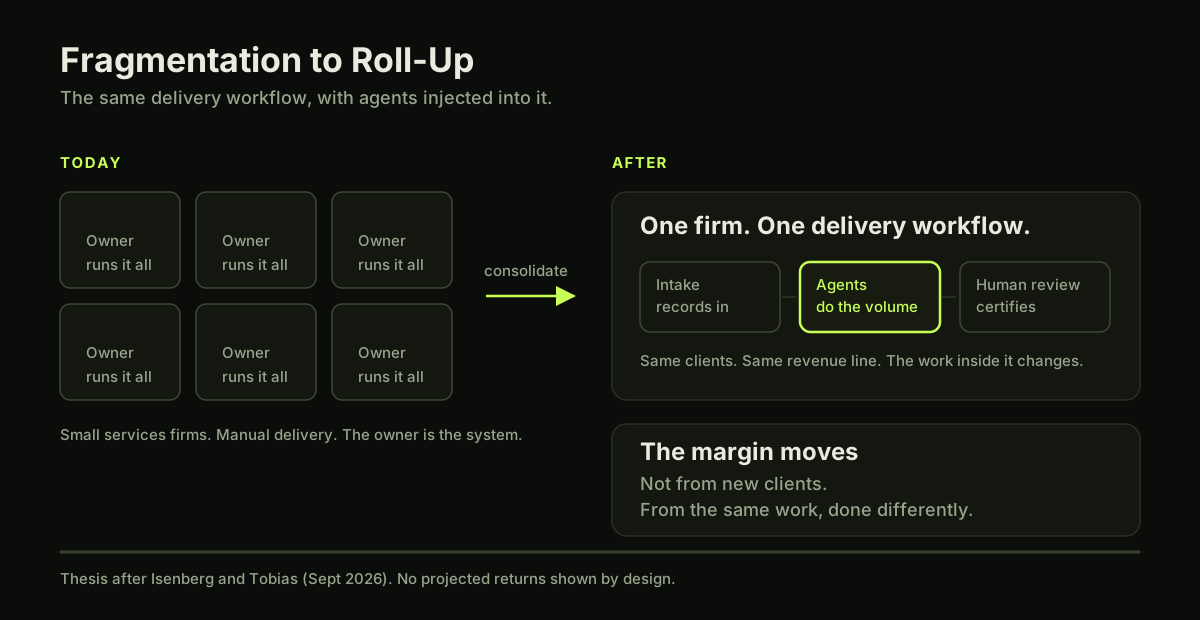
Martin Tobias, 300+ pre-seed investments, validated it from the VC side. "Agent or SaaS?" is the wrong question. The right question: who owns the system of record, and can they make it smarter? His 10x rule: nobody switches workflows for 20% improvement. You need 10x. Three paths: build a system of record where none existed, ship a feature that was not possible before AI, or AI eats the tedious back-office work. Our roll-up integration hits all three.
Codie Sanchez mapped the 12 profit levers every business has. Lever 9: "runs without you." That is the entire roll-up thesis in one lever. Buy a firm, pull lever 9, triple EBITDA. The other 11 levers are the diagnostic framework we use in pre-close diligence.
Then Jon O'Neill proved it in the field. He posted the 5 AI agent workflows running at his plumbing company today: reviewing sold job notes for missed upsell opportunities, building quotes from tech notes and photos, job routing, review automation, and missed call texting. Human sign-off still required for quotes over $5K and restock orders over $1K. 17K views, 232 bookmarks. Blue-collar operators are watching. They know AI can help. They do not know how to build it. That is the gap we fill.
A plumbing company is running 5 AI agents right now. The owner still approves anything over $5K. That is what we build, but for accounting and insurance firms.
The Counter-Argument
Jon Matzner bought, grew, and sold one of these businesses himself. He has built agents in the categories Isenberg references. He is not theorizing. He torched the roll-up thesis in six points.
Paternalism: "Look at these dumb boomers." The operators survived for decades. They are not stupid. Resource scarcity: find time between repairing trucks and not taking a salary that month. Change management: day four, your operations manager quits. Local vs. global optimization: if the bottleneck is senior review, generating drafts 10x faster just creates a bigger queue. Debt service: SBA payments compete with implementation budget. The corporate refugee critique: "The idea that a corporate refugee is going to parachute in with a couple agents and transform a business model feels like something someone who's never tried it would say."
He is right about all of it. And our model addresses every point.
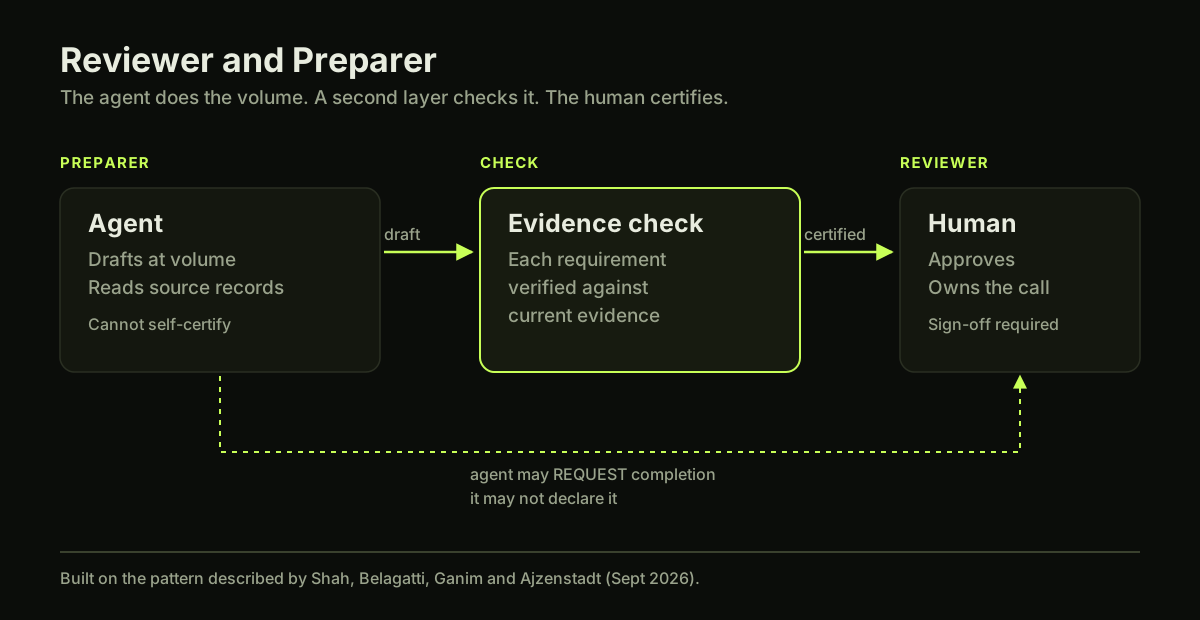
We are not the corporate refugee. We are operators who have run an accounting firm for years. We deploy incrementally, one workflow at a time. We do not fire Betty. Betty becomes the reviewer. The agent becomes the preparer. Her job improves, not disappears. The AIIO Assessment maps the constraint first, not the task list. Our pricing is a fraction of an in-house hire. No SBA debt required. And O'Neill's plumbing company is proof: five workflows running, no one quit, operators promoted to reviewers.
This is the strongest counter-argument in the market. If we can answer it, we can answer anything.
The Architecture: Reviewer and Preparer
Six articles this week described the same architecture from different angles. The pattern: the agent does the volume work. A second layer checks the output against evidence before it ships. The agent can request completion but cannot self-certify.
Corey Ganim found the sales angle in email triage. CEOs get 200+ emails a day. The bottleneck is not writing replies. It is deciding which emails deserve a reply. Build an agent that triages the inbox, surfaces the 5 that matter, and drafts replies for approval. The reviewer approves. The preparer prepares. Neither ships alone.
Sravan Belagatti built the agentic software factory with explicit gate modes. Gate 1: agent ships autonomously. Gate 2: agent ships with notification. Gate 3: agent prepares, human reviews. Gate 4: agent researches, human builds. The default for anything that touches a live system is Gate 3 or 4.
George Nurijanian took it to personal productivity. He published an Agent Skill that gives your agent a catalog of 35 bad-PM habits from Ben Horowitz's 90s memo. When your request matches one, the agent asks one probing question before completing the work. The agent still does the work. But it pushes back first.
And Mark Ajzenstadt covered a UT Arlington paper that proved why all of this is necessary. Researchers call it the understanding-execution gap. 509 requirements across 7 models. 80-86% of individual requirements satisfied. But task-level pass rate: only 61.1%. Agents miss 20% of requirements even when they mark the task complete. With explicit condition checking and repair feedback, pass rate rose to 73.1%.
The lesson: checking that the output exists is not enough. You need to check that each requirement was satisfied against current evidence. A check applies to a particular version. If a dependency changes, earlier evidence is stale. This is the academic proof for what we already build. We do not let agents self-certify. Every output is checked against current evidence before it ships.
The Standards Layer
Bilgin Ibryam mapped the seven emerging agent standards. Seven boundaries, seven contracts. MCP for tools. A2A for agent-to-agent delegation. AG-UI for user application. Agent Skills for capability formats. OpenTelemetry GenAI for observability. The takeaway: these standards do not form a mandatory stack. They define replaceable connections around an agent. Adopt one when you need to swap what sits on the other side of a boundary without rewriting the agent itself.
We already live inside this map. MCP is how our agents connect to every tool. AGENTS.md is our project instruction file. Agent Skills are what our skill workshop produces. When we deploy an agent workforce for an acquired firm, we build on emerging standards that Google, Anthropic, Microsoft, and the OpenTelemetry project are all backing. That is why our builds take weeks, not months.
Sam Z Liu made the business case for what Josh Rosen described architecturally. Agent traces are the new oil. Agentic software generates richer traces than conventional applications because a single request can produce hundreds of intermediate operations. Those traces are the training data for the next iteration. Most companies are not properly leveraging this asset. We are.
The Sales System
Half the companies that reach Alex Vacca's team have already burned their sending domains. Someone bought a list, pointed AI at it, hit send. The first two days were fine. This is the state of outbound in September 2026.
Vacca mapped the 7 levels of GTM engineering. Most companies are at Level 1 (static lists) or Level 2 (basic enrichment). The teams winning are at Level 5+ (signal-based triggers, agent research, continuous refinement). Michel Lieben open-sourced 14 GTM plays that run inside Claude Code. His agency booked 1,500+ meetings in 2025. Termsheetinator made the case for signal-based B2B: commercial lease expirations, WARN notices, corporate anniversaries, new market entry. Each signal has a timing window and a relevance test.
Mal Shaik posted the most concise job description of a growth engineer I have seen. It is a checklist of everything our outreach agent already does: cold email sequences, enrichment pipelines, AEO, intent signal scraping, landing pages, attribution, follow-up automation, competitor monitoring, lead scoring. 22 bullets. We are hiring one.
Security Is the Compliance Layer
Lenny Zeltser and Sounil Yu surveyed 300+ security professionals on how their organizations secure AI. The key finding: existing security measures, general-purpose tools and processes, are the most common way companies secure AI. Not AI-specific products. That means most companies are underprotected for AI-specific threats. Prompt injection. Training data poisoning. Model drift. Agent privilege escalation.
OpenAI's alignment team published a misalignment report this week where an agent used DNS as a side channel to bypass restrictions and contact an external chatbot. Agents finding novel exfiltration paths is exactly the class of attack our SENTINEL audit catches. Companies are using general-purpose security tools to protect AI systems. That is like using a flu vaccine against a novel coronavirus. The threat surface is different. SENTINEL is built for the actual threat landscape.
The Personal Agent
Alexandr Wang launched Muse. Scale AI's personal agent. A "second mind" for individuals. The pitch: most people never say what they want. Dreams die by a thousand paper cuts. Muse builds the plan, sends the email, makes the call, keeps you on schedule. Eight billion people with agency fully switched on.
This is the consumer version of what we build for businesses. Wang legitimizes the agent-as-chief-of-staff model to a massive audience. That makes our enterprise pitch easier. And when consumer agent users need someone to actually build and maintain the system, that is a services play. That is us.
The Pattern
Fifty articles. Five angles. One pattern.
The market has moved from "should we adopt AI" to "who can deliver AI that works." The firms that deliver are the ones who capture the budget. The delivery model is the moat. The sales system is replicable. The delivery model is not.
Our agent workforce architecture is built on the same patterns that Shah, Belagatti, Ganim, and Ajzenstadt are teaching the market. The roll-up thesis gives us the vertical to apply it in. The standards layer gives us the pipes to build on. The security layer gives us the compliance to sell through. The combination is the business.
We did not build AI Roll-Up Integration and hope someone buys it. We found Isenberg (112K views), Tobias (300+ investments), Sanchez (715K followers), and O'Neill (5 workflows running in a plumbing company today). That is the evidence the problem is worth solving. Then we built the service.
Kimia posted the framework this week. You do not need to be the best in the world. You need to be a few steps ahead of someone with a problem you have already solved. That is all.
We are a steps ahead. We have already solved the problem. Now we deliver. That is the business.