The Source of Permission.
The SaaS moat was owning data. The AI moat is owning permissions. Six research signals converged this week on one architecture, and we're already running it.

Something shifted this week. Not a single breakthrough. A convergence. Six signals from six different sources, all pointing to the same conclusion:
The source-of-truth era is ending.
The source-of-permission era is beginning.
Jamin Ball, Clouded Judgement (Altimeter Capital), June 12, 2026
Here's what each signal said, how they connect, and what it means for anyone building with AI agents right now.
Signal 1 The Clearinghouse Thesis
Jamin Ball's latest Clouded Judgement newsletter dropped this morning with a thesis that reframes the entire AI infrastructure debate. His argument:
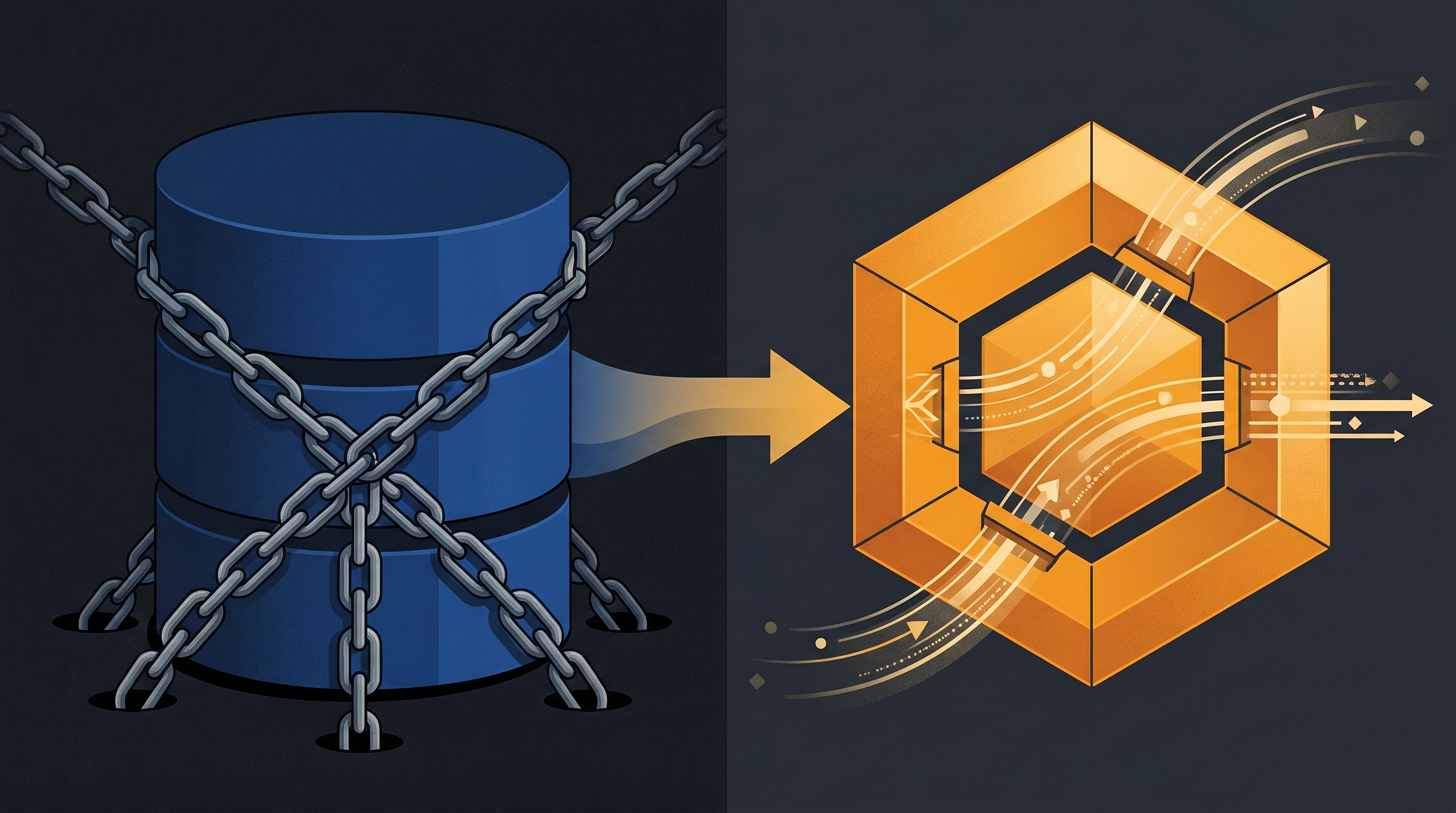
In SaaS, the moat was the system of record. Salesforce owned your customer data, Workday owned your employee data, NetSuite owned your financial data. Once everything integrated with the system of record, ripping it out was impossible. Data gravity + workflow lock-in = indestructible moat.
In AI, the moat is the clearinghouse. When agents from multiple vendors act autonomously, touch critical data, and spend money, someone has to sit in the middle and decide: which agent is cleared to act, on what data, with what limits, and can you prove what happened after the fact?
The clearinghouse controls four things:
Memory
What your agents know: the accumulated context that makes them useful
Context
What agents see and how it's served: the lens that determines what information reaches which agent
Execution
What agents are allowed to do: the permission boundary between thinking and acting
Governance
Who's allowed to do what, plus the audit trail behind all of it
Ball's money line: "The source-of-truth era is transitioning into the source-of-permission era. Founders should pick their path to the clearinghouse now, because in 18 months there won't be room to be undecided."
Three camps are racing for the clearinghouse seat. Data players (Snowflake, Databricks) believe data gravity becomes clearing gravity. OS players (Microsoft) believe owning the surface where employees kick off agents wins. Agent-native startups believe an entirely new layer emerges.
But the most strategic position? The neutral cross-clearinghouse, governing across all agent vendors. No enterprise runs only Microsoft's agents. Microsoft can't credibly govern Salesforce's agents. That neutral seat is the most strategic real estate in software.
Signal 2 The Loop Is Solved. The Harness Is the Product.
Peter Wang, CEO of Shortcut AI, published a piece that cuts through the agent framework noise: "The basics have been standardized over the past year: an agent is a while-loop around a model."
His thesis: the loop is solved. The harness is the product. The moat isn't the model. It's the proprietary workflow data your product accumulates every day just by running.
Three dimensions where vertical agents win:
Data
Domain-specific, proprietary, accumulates with use. Not the public web. The stuff that only exists because your product runs in that industry every day.
Workflow
Embedded in existing SOPs, hard to rip out. Not bolt-on AI. AI that lives inside the process and can't be removed without breaking the workflow.
Trust
Industry certifications, audit trails, compliance. Not lowest common denominator. The specific certifications and compliance frameworks that industry demands.
Seven components make up what Wang calls the Vertical Agent Anatomy. The LLM is the smallest component by engineering hours. The router, specialist models, supervisors, tool layer, memory system, and eval framework are where the real engineering lives.
Signal 3 Scaffolding Is Dead. Contract Is Not.
Anthropic released Claude Fable 5 and Mythos 5 this week: 80.3% SWE-Bench, 1M context window, $10/$50 per million tokens. But the deeper story isn't the benchmarks.
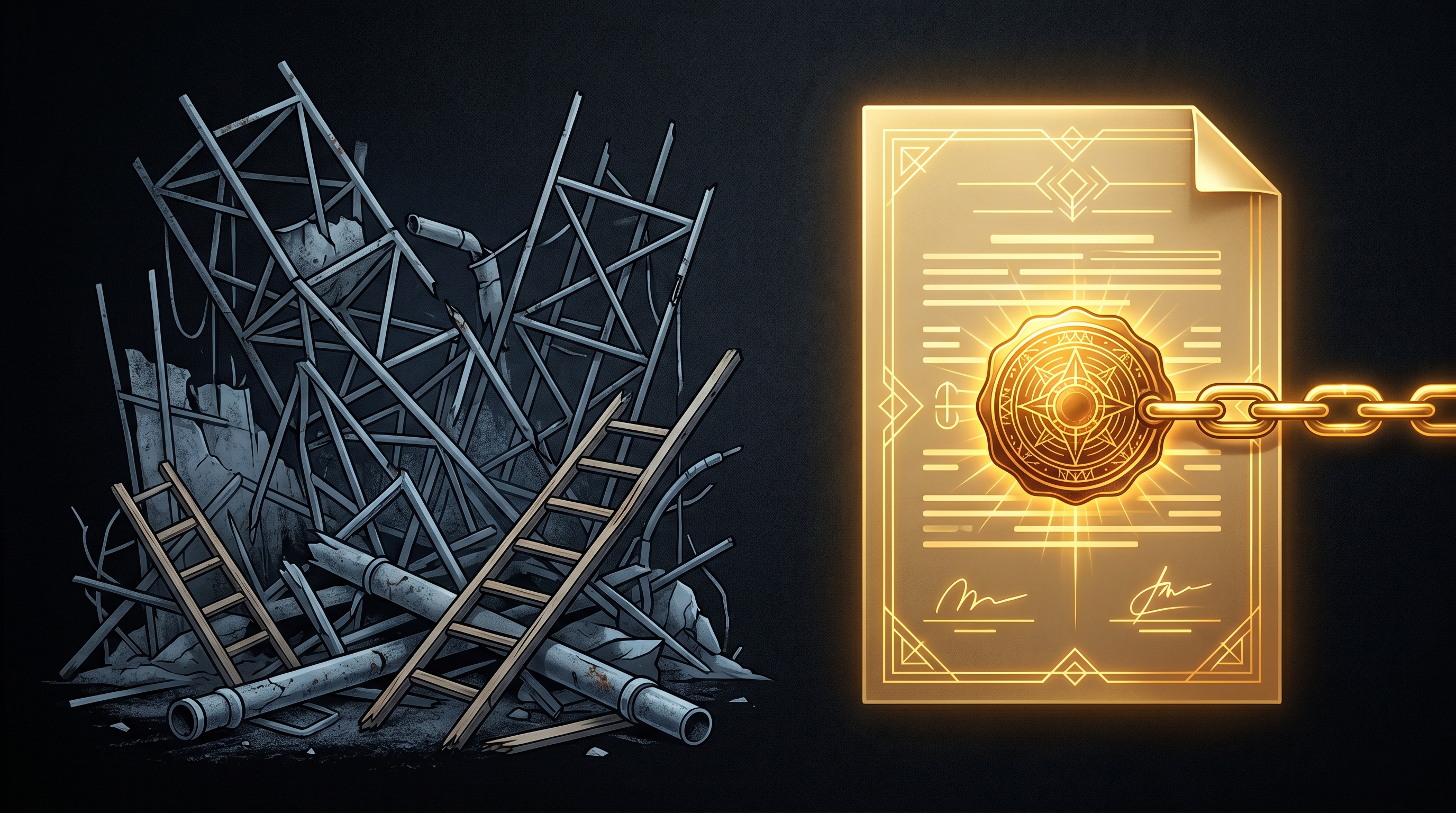
Compensation scaffolding is obsolete. The 9-step procedures, self-verify loops, MUST/ALWAYS/NEVER blocks, and elaborate chain-of-thought chains we used to make weaker models behave? Fable 5 doesn't need them. The model is smart enough to reason without being hand-held through every decision.
But contract scaffolding is more important than ever. The rules that define what an agent IS, what it CAN do, what it MUST NOT do, and what happens when it breaks those rules. That's not compensation for a weak model. That's governance. That's the clearinghouse.
OBSOLETE: Compensation Scaffolding
- ✗ 9-step procedural instructions
- ✗ Self-verify loops after every action
- ✗ MUST/ALWAYS/NEVER emphasis blocks
- ✗ Elaborate chain-of-thought chains
- ✗ Redundant confirmation steps
ESSENTIAL: Contract Scaffolding
- ✓ Identity: who this agent is and its role
- ✓ Boundaries: what it can and cannot do
- ✓ Absolute prohibitions with zero tolerance
- ✓ Enforcement and discipline procedures
- ✓ Audit trails for every action
This distinction is critical. Anyone who conflates the two will over-simplify their agent governance, removing the contract scaffolding along with the compensation scaffolding, then watching their agents run wild in production with no guardrails left.
Signal 4 Agents That Know When to Stop
@hooeem's piece on agent termination architecture addresses the problem nobody wants to talk about: agents that don't stop. Infinite loops, hallucinated completions, escalating retries burning through tokens and budget.
The solution isn't better prompts. It's architecture.
Completion States
Define what "done" looks like before the agent starts. Not "write a good analysis" but "every competitor analyzed, every gap identified, every finding sourced." The agent runs until it converges on the completion state.
Action Deduplication
Hash tool + arguments. If an agent tries the same action twice, reject it. This kills infinite retry loops.
Structured Error Envelopes
Every failure returns a typed error with code, message, field pointer, and doc URL. No ambiguous "something went wrong." The agent can reason about the error instead of hallucinating a fix.
Circuit Breakers
If an agent fails N times on the same task, escalate to a human. Don't just retry harder. The harness catches what the model can't.
This is the clearinghouse in microcosm. The termination architecture is the permission boundary. It defines what the agent is allowed to do, what happens when it exceeds those boundaries, and who gets notified.
Signal 5 Loops, Not Labor
@ericosiu's piece on rebuilding the agency org chart around loops, not labor, reframes the entire business model.
"Buying agents without designing loops first creates AI theater. Many bots. Weak outcomes."
Eric Siu, Managed Growth Loops
The org chart flips: account managers become outcome owners, channel specialists become loop owners. The agent isn't doing labor inside an existing org structure. The org structure is the loop, and the agent is the worker inside it.
This pairs perfectly with the termination architecture. Loops tell you what runs. Termination tells you when it stops. Together they define the complete lifecycle of an autonomous business process.
Signal 6 Losing the Front Door
Ball's December post on the same thread provides the historical parallel. Before the internet, GDS systems (Sabre, Amadeus) were both the system of record and the front door for travel booking. Then OTAs (Booking.com, Expedia) captured the new front door: consumers booking directly. The GDS stayed as the back-end truth, but lost the economic upside.
| Entity | Role | Market Cap |
|---|---|---|
| Amadeus (GDS) | Survived as system of record | ~$30B |
| Sabre (GDS) | Lost the front door | <$1B |
| Booking + Expedia (OTAs) | Captured the new front door | $200B+ |
Same pattern now in enterprise software. Legacy SaaS owns both the data and the front door (human UI). Agents create a new front door. Whoever captures it captures the value. Satya Nadella compared legacy SaaS apps to a "dumb DRAM database." Whether that's fair or not, the market is pricing it as true.
The Convergence
Six signals. Six different sources. One architecture:
| # | Source | Core Insight | Clearinghouse Pillar |
|---|---|---|---|
| 1 | Jamin Ball (Altimeter) | The clearinghouse controls memory, context, execution, governance | All four |
| 2 | Peter Wang (Shortcut AI) | The harness is the product: data, workflow, trust | Memory + Governance |
| 3 | Anthropic (Fable 5) | Compensation scaffolding obsolete, contract scaffolding essential | Execution + Governance |
| 4 | @hooeem | Completion states, action deduplication, circuit breakers | Execution |
| 5 | @ericosiu | Loops, not labor: agents are loop workers inside designed processes | Execution + Context |
| 6 | Jamin Ball (Dec 2025) | Capturing the new front door dwarfs owning the underlying system of record | Context |
Every signal maps to a clearinghouse pillar. The architecture isn't theoretical. It's the thing everyone building production agent systems converged on independently this week.

What Prospyr 305 Is Building
We didn't read these signals and then design our stack. We designed our stack, then read these signals and discovered the field converging on the same architecture. That's the strongest validation possible.
Here's how our architecture maps to the clearinghouse:
Daily logs accumulate into MEMORY.md (hot), MemPalace + Briefs (warm), raw transcripts (cold). Agents retrieve on demand via memory_search. No agent starts from zero. Every agent has access to the full organizational knowledge base.
Eaststar (office ops), Northstar (COO, heavy compute), Southstar (eng/security), Zo (client-facing). Each agent sees different context, has different capabilities, and serves different functions. The system serves each agent the context it needs, not a firehose of everything.
Read-only, Scaffold, Sandboxed, Live state, Actions. Every execution tier requires progressively more authorization. The Agent Code of Conduct defines absolute prohibitions, enforcement discipline, and command responsibility. Delegation is never absolution.
Every agent action is logged. External actions (emails, messages, deployments) require human approval. And because we're not Microsoft, Anthropic, or Salesforce, we can govern across whatever models and tools our clients use. That's the neutral seat Ball describes as the most strategic position in software.
The AIIO Reframe
This convergence changes how we sell what we do. Our AIIO (AI Infrastructure & Operations) assessment has been positioned as "AI readiness", evaluating whether your business is prepared for AI agents.
That's underselling it by 10x.
The new framing: AIIO is clearinghouse readiness. We're not telling you if your AI is good. We're telling you if you can prove what your agents did, set policy on what they can touch, and show your auditors.
Old Frame: AI Assessment
- →Is your AI good enough?
- →Do you have the right models?
- →Can agents do the work?
- →Nice-to-have for forward-thinking companies
New Frame: Clearinghouse Readiness
- →Can you prove what your agents did?
- →Can you set policy on what they touch?
- →Can you show your auditors?
- →Mandatory for any company running autonomous agents
Same product. Same assessment. 10x the urgency. CIOs aren't asking "is the model good?" anymore. Every model is good enough. They're asking: "Can I see what every agent did, set policy on what it can touch, and prove it to my auditors?" That's what we sell.
What's Coming
The architecture is in production. Now we scale it.
Vertical Clearinghouses
We're building industry-specific governance layers, starting with healthcare (HIPAA), insurance (DWC compliance), and financial services (SEC/fiduciary). Each vertical gets its own clearinghouse: specific permissions, specific audit trails, specific compliance frameworks. Ball calls this the "vertical clearinghouse path": earn clearinghouse status in an industry the horizontal players won't go deep on.
Cross-Clearinghouse Governance
No enterprise runs one vendor's agents. We're building the neutral governance layer across Anthropic, OpenAI, Google, and self-hosted models. Set policy across all of it, clear actions across all of it, hold the audit trail across all of it. Microsoft can't do this. Anthropic can't do this. We can.
Agent Economy Payments
Three hackathon projects (AP Agent on Kite Chain, AgentPay on Solana, Agent Studio on AWS + Coinbase) proved the payment layer works. Next: production-grade agent-to-agent commerce with on-chain audit trails. Every agent payment goes through the clearinghouse.
Hackathon Sprint
Three active hackathon submissions this summer: UiPath AgentHack ($50K), Slack Agent Builder ($42K), Build with Gemini XPRIZE ($2M). Each tests a different angle of the clearinghouse thesis: governance integrations, multi-agent collaboration, and vertical AI delivery.
The Bottom Line
Six signals. Six sources. One architecture. The field converged this week on the clearinghouse thesis, and we're already running it.
The SaaS moat was data. The AI moat is permissions. The companies that own the governance layer, the thing that decides which agent is cleared to act, on what data, with what limits, and can prove what happened after the fact, those companies win the agents era.
We didn't design our architecture to match a thesis. We designed it from first principles to solve real problems for real clients. The fact that the most rigorous minds in venture capital, AI research, and agent architecture independently converged on the same structure this week? That's not luck. That's pattern recognition.
The source of truth era is ending. The source of permission era is here. We're building the clearinghouse.
6
Research signals converged this week
4/4
Clearinghouse pillars already in production
18
Months until "no room to be undecided"
Sources
- Systems of Record Won the SaaS Era, Clearinghouses Will Win the Agents Era, Jamin Ball, Clouded Judgement (June 12, 2026)
- The Front Door to the Systems of Record, Jamin Ball, Clouded Judgement (Dec 19, 2025)
- Building a Good Vertical Agent, Peter Wang, Shortcut AI (June 11, 2026)
- Claude Fable 5 & Mythos 5 GA, Anthropic (June 11, 2026)
- Agent Termination Architecture, @hooeem (June 2026)
- Managed Growth Loops, @ericosiu (June 2026)
- Agent Code of Conduct, Franklin J Bryant IV (May 2026)
Building your clearinghouse?
We design and operate governance layers for AI agent infrastructure, from assessment to production. If you need clearinghouse readiness, let's talk.
Get in touch →