The succession gap.
On Thursday a four-trillion-dollar company lost its chief executive before lunch, handed the job to the CFO who kept her old one, and appointed the first board chair in its history — one release, no cause given, no successor named. I read it once as governance. Then I read it again as a warning about my own vendors.
This is an opinion column. Every factual claim is sourced at the foot of the page. The judgments are arguments, and you are welcome to disagree with them.
The argument, before the facts
I have never met Jensen Huang and I have no inside knowledge of NVIDIA. What I do have is a working life spent watching businesses discover, usually on a Tuesday, that one person or one vendor was the entire plan. So when a four-trillion-dollar company published three paragraphs saying its founder was gone as of this morning, no reason given, no successor named, I did not read it as a scandal. I read it as an admission.
Here is the thing that stuck with me. The release is not badly written. It is well written. Every sentence does a job, and the job is to be true without saying anything. That is a real skill. It is also exactly what a company sounds like when it has spent years rehearsing an emergency it never actually planned for.
Three paragraphs, no cause
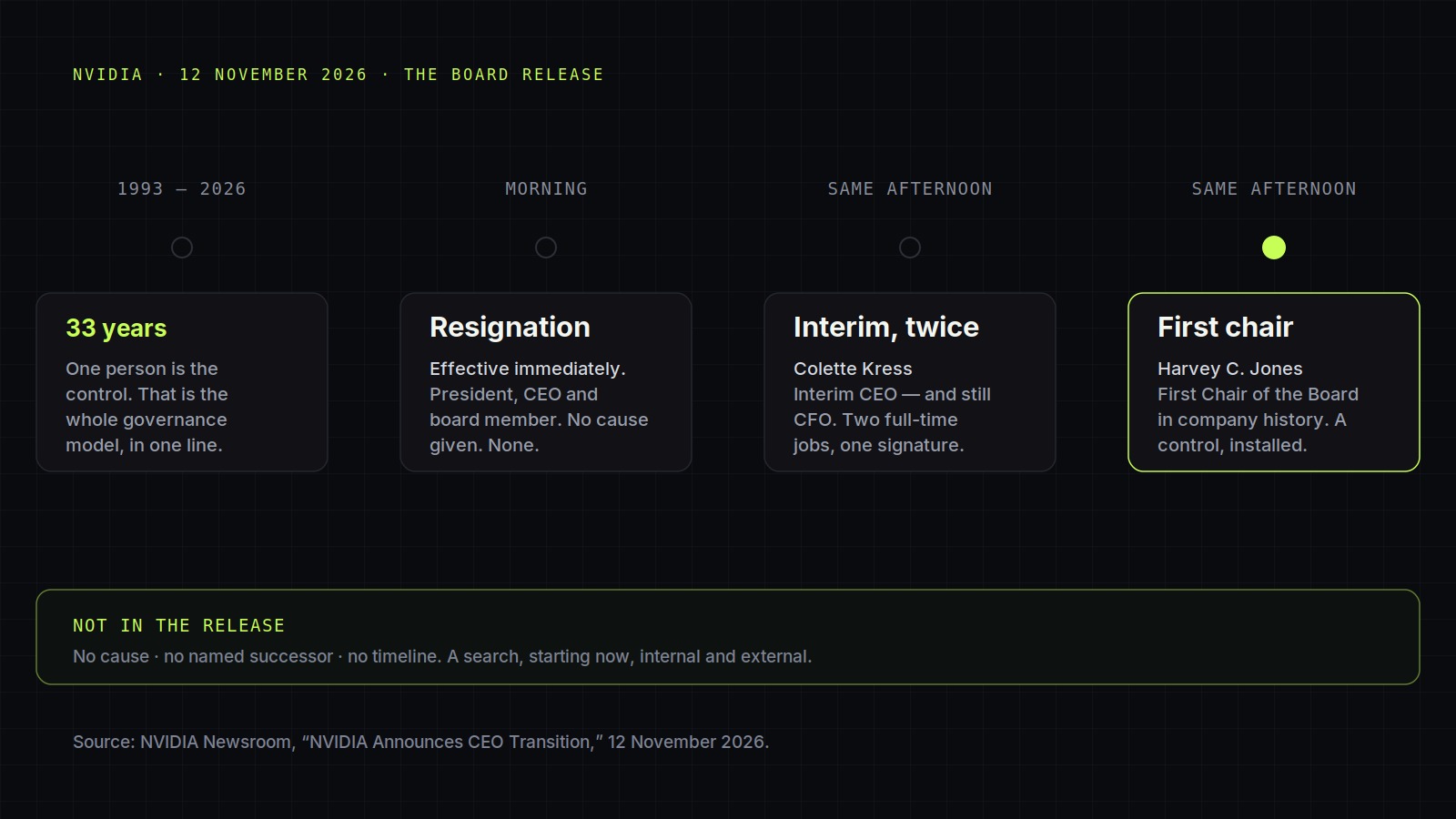
On November 12, 2026, NVIDIA's board announced that Jensen Huang had resigned as President, Chief Executive Officer and a member of the Board, effective immediately.
Colette Kress, the Executive Vice President and Chief Financial Officer, agreed to serve as interim CEO, keeping the CFO role while she does it, until a permanent successor is named. The Board said it is starting a search and will consider internal and external candidates.
Separately, the Board appointed Harvey C. Jones as its first-ever Chair. Jones has been an entrepreneur, technology executive and venture investor for over thirty years, including as CEO and Executive Chairman of Synopsys.
That is the whole substance of it. Three sentences of fact, a search to be conducted, and two quotes about confidence. If you read only the headlines you will think this is a story about a man. It is a story about a company that, on the day it needed one, produced an org chart.
What is missing from it
The release gives no reason for the resignation. None. Not a family matter, not a health matter, not a disagreement. Nothing. Press accounts have supplied their own explanation, and I am not going to lean on it here, because the governance facts stand up without it and the personal ones are unverified by the primary document.
More telling is what is absent structurally:
- No named successor. Not "the board has been planning for this", but a search starting now, internal and external.
- The interim keeps both jobs. Kress is now the chief executive and the chief financial officer. That is two full-time roles, one of which signs the financial statements, held by one person during the most scrutinised quarter in the company's history. It is a real expression of confidence in her. It is also what you do when the bench is thin.
- The first chair in company history. A board that has never had an independent chair has one the same afternoon. That is not a coincidence; it is a control being installed because the control that was there, the founder, just left.
Thirty-three years of a company being one person's judgment call, and the plan for the day he isn't there is a press release written in the past tense. I keep coming back to that sentence because it is the whole article. A succession plan is not a document you write when the emergency starts. It is the document that makes the emergency boring.
The market's vote
The stock fell as much as 14% before recovering to close down 4.3%, which is the market saying something more interesting than "panic." It is repricing a leadership premium into a leadership discount, and doing it in hours.
The bigger number is the week: more than $740 billion of market value gone since the prior Friday's close, roughly $2 trillion off the October peak, and a valuation that fell below $4 trillion for the first time since 2025. Whatever you believe about AI capex, that is the sound of a single point of failure being priced.
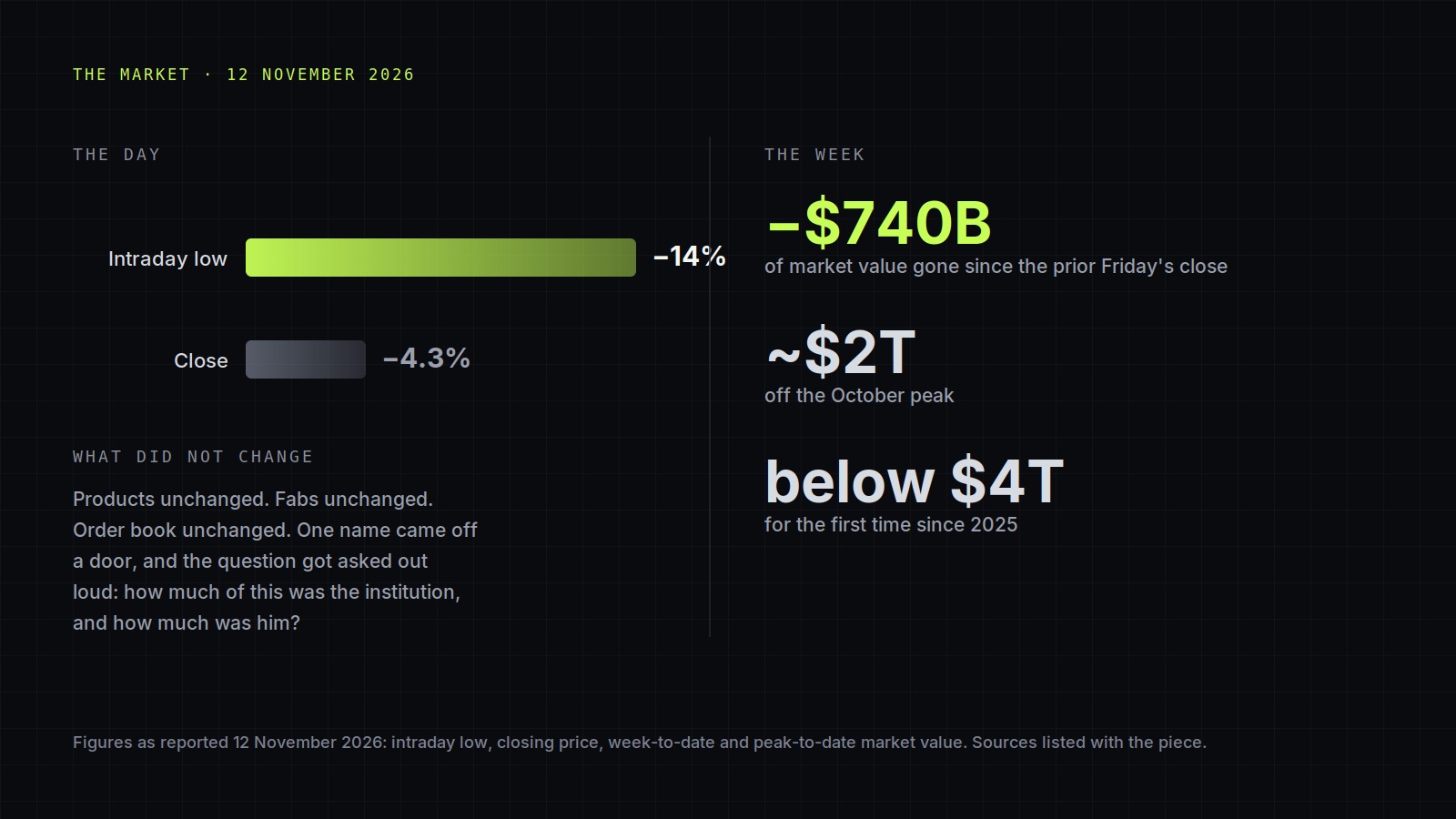
Note the shape of it. The company's products did not change on Thursday. The fabs did not change. The order book did not change. One name came off a door and a trillion-dollar question got asked out loud: how much of this was the institution, and how much was him?
My first answer was that most of it was the institution, and the market knows that. The second half of that is true. The first half I am less sure about, and the reason is the story going around about how NVIDIA actually got its supply.
The version circulating — and it is a story, not a filing, so treat it as one — is that NVIDIA's priority on the most advanced process at TSMC and on HBM from SK Hynix never rested mainly on contracts. It rested on Jensen Huang turning up in person, repeatedly, for twenty years, until the queue bent around him. If that is even half right, then the moat was not only the toolchain and the order book. Some of it was a man's address book, and there is no line item in the accounts for that.
What the market actually could not price was narrower than "will the business survive." It was: who decides next week, and does the person who holds the queue still answer the phone. Money does not run from bad news. It runs from ambiguity.
"Without interruption" is a claim, not a fact
The chair's quote is careful and it is worth reading twice: he expects the company's operations, customer commitments and product roadmap to continue without interruption.
Expects. That is a forecast in the mouth of the person who now has to make it true. It is not a warranty, and it is testable. NVIDIA reports third-quarter fiscal 2027 results on November 17, five days after the announcement, with the call at 2 p.m. PT.
| What to watch on 17 November | What it would mean |
|---|---|
| Guidance reaffirmed in the same language | The pipeline outlived the man. "Without interruption" starts becoming a fact. |
| A large customer disclosed as paused or re-scoping | The dependency is not only internal. Procurement committees hedge faster than boards. |
| Kress opens the call as both CEO and CFO | The interim arrangement is being worn in public rather than papered over. Watch who answers the margin questions. |
Put that date in your calendar whether or not you own the stock. If a company can absorb this in five days, "without interruption" becomes a fact. If the call is rearranged, it stays a claim, and the whole supply chain that plans around it should notice.
The China story, in three parts
Opinion, with the reporting cited. This is the section where I stop describing the release and start telling you what I make of the noise around it.
Since Thursday the theory going around trading chats and group texts is that NVIDIA was routing its best silicon into China anyway: that the export controls were a press release and the enforcement was theatre, and that this year's Chinese frontier models are the receipt. DeepSeek's V4 Flash and V4 Pro. MiniMax's M2.7. Trained in China, quantized on NVIDIA hardware, running on NVIDIA parts. Follow the chips and you find the smoking gun.
It is three different claims wearing one coat. Only one of them survives contact with evidence, and it is not the one people are repeating.
1. "NVIDIA engineered a way around the controls."
Unfounded, as far as I can find, and I looked. There is no document, no filing, and no on-the-record allegation that the company designed its own route around export controls. What exists is narrower and stranger: in February, a senior administration official told Reuters that DeepSeek's newest model had been trained on Blackwell (the chip the US does not ship to China), likely at a data centre in Inner Mongolia, and that DeepSeek would strip the technical indicators that would give it away. NVIDIA declined to comment. The Commerce Department and DeepSeek did not respond.
An official's claim with no artifact attached is still a claim. I am not going to launder it into a fact, and I am not going to treat the absence of a denial as a confession. It sits in the same place as everything else in this section: worth watching, not worth repeating as though it were settled.
2. "The chips got there anyway."
This one is not really a conspiracy, because the diversion is documented and the paperwork is public. In March, the co-founder of Super Micro was arrested over a scheme to move NVIDIA-equipped servers to China through Taiwan and Southeast Asian intermediaries, using falsified documents and dummy equipment to pass audits. The scheme was valued at roughly $2.5 billion. Days later, three people were charged over 750 servers worth about $170 million ordered with certifications swearing they were not bound for China. Congress responded by advancing a bill that would put tracking directly into the chips.
None of that requires NVIDIA to be complicit. It requires NVIDIA to be unable to see its own hardware once a distributor has it. Those are different sins, and the second one is the more common failure in every supply chain I have ever audited.
3. "They were quantized on NVIDIA chips, so NVIDIA is behind the models."
Here is where the theory eats itself, and it is the part I find genuinely interesting, because the evidence is not hidden. It is published, with a licence file, on NVIDIA's own Hugging Face organisation:
- nvidia/DeepSeek-V4-Flash-NVFP4, listed 28 May 2026. A quantized version of DeepSeek's open-weight model: 284B parameters total, 13B active, compressed with NVIDIA's own Model Optimizer, targeted at Blackwell, MIT licence, and under deployment geography the card says one word: global.
- nvidia/DeepSeek-V4.1-Flash-NVFP4 and nvidia/MiniMax-M2.7-NVFP4, the same pattern, same organisation, same naming convention.
- An NVIDIA developer blog post from April 2026 titled, without a shred of irony, MiniMax M2.7 Advances Scalable Agentic Workflows on NVIDIA Platforms: 230B parameters, FP8 kernels contributed upstream to vLLM and SGLang, a NIM container, day-zero support.
So yes: those models run on NVIDIA hardware, and NVIDIA ships the build that makes them run. That is not a leak. That is a product line.

And here is the word carrying all the weight in the rumour: quantized. Quantization is a compression step performed on weights that already exist, to make a model cheaper to serve. A card that says NVFP4 tells you where a model runs best. It tells you nothing about what the model was raised on. A model trained on Huawei silicon and later compressed for Blackwell looks identical on that page to one trained on a Blackwell cluster, and nothing DeepSeek has published settles it either way.
So "they were quantized on NVIDIA chips, therefore NVIDIA trained them" is not a scandal. It is a category error with a stock chart attached, and it is being repeated by people who would never accept the same logic about anything else.
For NVIDIA's critics, the uncomfortable fact is that no back door was needed. The company spent a decade building the toolchain that every serious model gets built and served on: the compilers, the kernels, the container, the optimized build of somebody else's weights with its name on the label. You do not have to smuggle a platform. It is already in the building. Open weights plus a permissive licence plus day-zero support means the most efficient place to run a Chinese frontier model is, awkwardly, an American GPU.
For NVIDIA's shareholders, the uncomfortable fact is the mirror image: this is a moat made of habit, not of scarcity. A chip can be tracked, tariffed, licensed and legislated. A toolchain cannot. You cannot put a tracker in a CUDA kernel, and every enforcement bill I read this year is written as though the object of the fight is a crate. I think the fight is over an ecosystem, and ecosystems do not read statutes.
That, to me, is the story of the year, and almost nobody covering the resignation is covering it. One man's exit will be resolved in a quarter. The other question, whether American policy can govern a technology whose advantage lives in software layers it does not control, will outlive every CEO involved.
None of which changes your exposure, and this is the part I would say to a client: you cannot influence chip policy and you are not going to out-research a trading desk. You can find out whether the model your business runs on has a second home. That is a Tuesday problem, not a Washington one.
Who benefits from him being gone
Opinion again, and the most speculative thing on this page. I will tell you exactly where the evidence stops.
Within hours of the release, a second theory started moving, and it was nastier than the China one. The short version: he was removed on purpose, by people who could not beat him in the open. One account with a large following put it over a cartoon titled Permanent Underclass and captioned it, "Here's why they crucified Jensen. Don't let them psyop you, they have nothing special." Half a million people saw it by the weekend.
The cartoon is worth describing because the argument is in the picture, not the caption. Along the top, on a cloud, sits Local AI: happy people running open models, quantization, self-hosting. Below them are walled compounds marked OpenAI, Anthropic and xAI, one of them flying a banner that reads compute is all that matters. And beneath the wall is the underclass, holding signs. Productivity quota: 0.0001 tokens per day. You will own nothing and be happy. Any leftover tokens? A pipe labelled slop pours down on them from above.
Here is my read, and I will separate the two halves because one is nonsense and the other is not.
The conspiracy half is unfounded. Nobody has produced a document, a filing, or a credible account of a coordinated campaign to remove a chief executive from the company that supplies their own compute. Companies do not usually destabilise their silicon vendor to win an argument about licensing. The people making this claim are guessing from motive, and motive is the cheapest evidence there is. If that is the whole of the theory, it belongs next to the chip-smuggling one: loud, satisfying, unsupported.
The structural half is not nonsense at all. Look at whose economics depend on what. NVIDIA's business has spent a decade getting more valuable as more people run more models, on hardware they bought. Its own Hugging Face organisation publishes optimized builds of other companies' open-weight models, MIT licensed, for global deployment. Whatever Jensen Huang believed personally, the company he ran was structurally on the side of weights getting out into the world, because that is what sells GPUs.
The closed labs run the opposite trade. Their margin comes from a model you cannot hold, served by the token, improving on a schedule you do not control. Every open-weight release that lands within a version or two of the frontier is a discount on that margin. Both models can be honest and profitable at the same time. They cannot both be dominant.
So when the most prominent advocate the open camp had inside the compute vendor leaves in a morning, with no successor named and a CFO holding the chair, the open camp loses its most useful ally in the room. Whether anyone did that to him is unknowable from here. That it benefits the people selling scarcity is arithmetic. And an interim chief with two jobs does not pick that fight in her first quarter. Neither does a chair appointed the same afternoon.
One pushback on the cartoon, though, because "they have nothing special" is the weakest line in it. They do have something: distribution, a billing relationship, and a model that gets better while you sleep. What they do not have is a reason for you to stay once switching costs fall to zero. The underclass in that picture is not a conspiracy either. It is a business model drawn honestly, and the punchline is that most people volunteered for it because the API was easier than the alternative.
Which is the same conclusion as the rest of this piece, arrived at from a different direction. You cannot vote on who runs NVIDIA, and you cannot litigate which camp wins. You can decide, this month, whether your operation survives the answer. The preppers hoarding weights on Reddit have already made that decision. Most businesses have not.
The claim underneath the conspiracy
Since Thursday, one version of the "why" has travelled further than the others, and it is worth taking apart properly because a lot of people I respect have repeated it. The economist Richard Werner put it this way: use only open models you can download and run offline, because the terms on the closed ones mean you hand over the intellectual property you mention, the provider sells it on, and small firms have been undercut by a new competitor offering the same work cheaper within months.
Three claims again, and this time two of them matter to you whether or not you care about NVIDIA.
The part that is checkable, and that you should check this week. The terms on AI services are not uniform and the differences are large. Consumer chat surfaces have generally reserved the right to use what you type to improve the model unless you turn it off. Business tiers and API access usually do not train on your inputs by default — but that is a default you can change in a settings page, and it varies by vendor, by tier, and by whether you are on a free plan. Nobody reading this knows which of those they are on. Go and look. It is a ten-minute job and it is the single highest-return thing in this article.
The part that is a category error. A licence to use your inputs is not the same as ownership of your business, and the leap from one to the other is doing a lot of work in that post. What most terms grant is broad permission to process and, on some tiers, learn from what you send. Whether that becomes a competitor serving your clients depends on something the terms cannot tell you: whether what you send is specific enough to copy, and whether anyone has an incentive to. That is an operational question, and it is answerable.
The part that is unfounded. That Jensen Huang was removed for opposing this, and that the whole thing is a coordinated takeover, is asserted with no document and no named case, and it has to explain away the appointment of a first independent chair and a CFO holding two jobs — which is what an institution looks like when it is trying to look stable, not what a coup looks like. The bankruptcies it describes may exist. Nobody has shown me one.
So here is the version I would defend. The conspiracy is noise. The mechanism it points at is real, it is documented in the terms you already agreed to, and it is a dependency most businesses have never priced — which is the same sentence as the rest of this piece, arrived at through the loudest possible door.
What this costs a 30-person business
Almost nobody reading this owns NVIDIA shares. Almost everybody reading this has, in the last eighteen months, wired some part of their business to a single vendor whose stability they have never once tested: the model API behind the assistant, the automation platform running the follow-up sequences, the one consultant who knows how the integration works.
The lesson of Thursday is not "AI is risky." It is narrower and more useful: a dependency you have never priced is not a strength, it is an unpriced risk. And it gets priced for you, in one morning, at the worst possible moment.
There is exactly one company in this story that removed the dependency instead of pricing it. Google trains Gemini on its own TPUs, and the claim travelling this week is that this makes it structurally independent of NVIDIA and structurally cheaper. Half of that is the strong version of a true thing. Google still buys NVIDIA at scale — for Cloud, not for its own training — and owning your silicon does not make capacity free, only cheaper to add. But the direction is right, and it is the deepest moat in the industry, which is why it is the example everyone reaches for.
Look at what it cost, though. A decade of designing chips, a foundry relationship, a compiler stack, and an army of people who could make all three work together. That is the same shape of investment NVIDIA made in CUDA, and it is the reason the answer for Google is not the answer for you. You are not going to build a fab. You are going to do the cheap version: know where your second home is, and test that it works once, before the morning you need it.
Here is what I would check this week in any small business running AI in operations. None of it requires a consultant, and all of it fits on one page.
List every workflow where one vendor, one account or one person is the only path. Be honest: if the answer is "all of them," write that down.
Can you get your data out, in a usable format, without asking permission? Do it once. The day you need it is not the day to discover the answer.
What happens Monday if the vendor is gone, the price triples, or the account is locked? One page, named owner, no heroics. A plan nobody has read is not a plan.
A number per month, and a named person who can see it. Unbounded usage is how a convenience becomes a line item nobody can defend.
If you cannot say whether the thing is working, you do not have a system; you have a subscription. Two checks a month, written down, beats any dashboard you never open.
Five items, one afternoon. It is the difference between a dependency you chose and one that chose you.
If I sat on that board
One more opinion, and then I will get out of the way. This is what I would be arguing for in the room, because the alternative is a company that spends a year describing itself as "in transition" and a market that prices every day of it.
Name the permanent CEO inside 90 days, or say out loud why the search takes longer. An interim holding two jobs is a decision with an expiry date nobody printed. Unstated timelines are how a temporary arrangement becomes the arrangement.
Split the CFO job from the CEO job this quarter. Not because she cannot do both. She plainly can. Because the person whose numbers are being scrutinised should not also be the person signing off on them. Concentration risk is not only a customer problem.
Publish the process, not the person. Boards treat succession like a state secret and then act surprised when the market assumes the worst. Say who is searching, what they are looking for, and when they will report back. "A search" is a verb, not a plan.
The part that should worry you most
Not the resignation. The speed. A $4 trillion company went from "stable" to "searching" inside a single news cycle, and the market repriced trillions before anyone had read the second paragraph.
Your business will not get a news cycle. It will get a Tuesday: the API key stops working, the account manager leaves, the platform raises prices 40% with thirty days' notice. The businesses that survive that Tuesday are the ones that wrote the one-page fallback while nothing was wrong.
NVIDIA will probably be fine. It has the balance sheet, the people, and a five-day clock to prove it. The rest of us should use the week to check whether we would be. And if the honest answer is "no," that is not a reason to feel bad. It is a reason to spend one afternoon.
Money does not run from bad news. It runs from ambiguity — and ambiguity is what a company has instead of a plan.
Sources
- 01NVIDIA Newsroom · "NVIDIA Announces CEO Transition" (12 November 2026)The resignation, Kress as interim CEO while remaining CFO, Jones as first-ever Chair, both quotes, and the 17 November earnings date.
- 02NVIDIA Investor Relations · same release, with the 17 November results datePrimary-source confirmation of the filing language and the scheduled Q3 FY2027 results and call time.
- 03The Wall Street Journal · markets live coverage, 12 November 2026Shares fell as much as 14% intraday and closed 4.3% lower; hundreds of billions wiped from market value.
- 04CNBC · Nvidia CEO Jensen Huang resigns: live updates, 12 November 2026More than $740bn lost since the prior Friday close, roughly $2tn off the October peak, and a close of $173.73 against a $239.24 October high.
- 05NBC News · Nvidia stock falls after Jensen Huang resigns, 12 November 2026Market value fell below $4 trillion for the first time since 2025.
- 06Reuters · "Nvidia CEO Jensen Huang resigns in blow to AI boom", 12 November 2026The resignation landing as a shock to the wider AI industry; cause attributed to reporting, not to the company release.
- 07Hugging Face · nvidia/DeepSeek-V4-Flash-NVFP4 model cardReleased 28 May 2026; quantized from DeepSeek open weights with NVIDIA Model Optimizer; 284B total / 13B active parameters; targeted at Blackwell; MIT licence; deployment geography listed as global.
- 08Hugging Face · nvidia/MiniMax-M2.7-NVFP4 model cardThe same NVIDIA-published quantization pattern applied to MiniMax M2.7, the second model the rumour names.
- 09NVIDIA Technical Blog · "MiniMax M2.7 Advances Scalable Agentic Workflows on NVIDIA Platforms" (11 April 2026)230B total / 10B active parameters, FP8 kernels contributed to vLLM and SGLang, NIM container, post-training recipes. NVIDIA is publicly shipping the deployment path for a Chinese open-weight model.
- 10Reuters · "China's DeepSeek trained AI model on Nvidia's best chip despite US ban, official says" (23 February 2026)The single on-record allegation that DeepSeek trained on Blackwell, sourced to a senior administration official, with Blackwells likely in Inner Mongolia; NVIDIA declined to comment. Cited as a claim, not a confirmed fact. The page is bot-blocked to automated fetches, so no link is published.
- 11Bloomsbury Intelligence and Security Institute · "AI Chip Smuggling: The Limits of US Export Controls" (6 April 2026)The Super Micro co-founder arrest on 19 March 2026 over a $2.5bn diversion scheme using falsified documents and dummy equipment, and the Chip Security Act advancing on 26 March 2026.
- 12US Department of Justice · "Chinese National and Two U.S. Citizens Charged with Conspiring to Smuggle Artificial Intelligence Technology to China"The 750-server, approximately $170m order shipped against false certifications.
- 13X · @0xSero, 13 November 2026 · the "crucified Jensen" quote-post over the "Permanent Underclass" illustration (x.com/0xsero/status/2121064369899590139)The circulating takedown theory and the cartoon's own argument: Local AI on a cloud, the closed labs walled off beneath it, the underclass below the wall. Cited as a claim in circulation, not as evidence for it. The illustration is third-party artwork and is described, not reproduced.
- 14Atlantic Council · "Beyond the spy scandal: What the Nvidia-Megaspeed case reveals about export controls"Megaspeed renting NVIDIA capacity across Southeast Asia to Chinese buyers through arrangements that do not violate current US export rules: diversion without complicity.
Every source above was checked at the primary document, not a second-hand summary.