The Cost of Waiting.
AI isn't just changing your industry. It's changing the cost of money itself. The businesses that adopt AI now will have lower operating costs and stronger margins when capital gets expensive. The ones that wait get squeezed from both sides.

Every business owner I talk to says the same thing: “I know AI is coming, I just need to figure it out.” They mean well. They’re not wrong about the direction. They’re wrong about the timeline.
Because this isn’t a technology adoption decision anymore. It’s a cost-of-capital decision. And the clock is already running.
The Harvard Math
Harvard Business School ran a study with 776 professionals at Procter & Gamble. Real product innovation challenges, not classroom exercises. The design was rigorous: professionals working with AI versus two-person teams working without it.
One person with AI matched the output of a two-person team.
Not slightly. Not marginally. They matched. Faster delivery. Higher quality. More balanced solutions that integrated perspectives outside the person’s functional area. And here’s the part nobody talks about: the AI-assisted workers had higher positive emotions and lower anxiety. They weren’t just more productive. They were happier and less stressed doing it.
The model used in the study was GPT-4o. Released May 2024. That’s 11 generations out of date by current standards. The tools we deploy today are dramatically more capable. The productivity multiplier isn’t theoretical. It’s measured, peer-reviewed, and already outdated.
Let that sink in. A model that’s ancient by AI standards doubled per-person output. What does a current frontier model do? What does the model coming in six months do? The gap between adopters and non-adopters isn’t widening linearly. It’s compounding. As I argued in Build the System, Not the Prompt, the advantage isn’t in the model. It’s in the system you build around it.
The Macro Squeeze
Here’s where it gets uncomfortable for the “I’ll get to it eventually” crowd.
Brett Winton, Director of Research at ARK Invest, laid out the macro picture in a thread that got 3.2 million views. Elon Musk replied with a hundred emoji. The thesis is straightforward and terrifying if you’re a stable business owner:
AI infrastructure investments have such extraordinary returns that they’re crowding out traditional business financing. Datacenter buildouts are scaling into the trillions. Nvidia chips hold their value well enough to serve as debt collateral. AI infrastructure debt competes with corporate debt, first at the high-yield level, then at investment grade. As annual datacenter capex becomes meaningful relative to total global corporate issuance, stable businesses that have nothing to do with AI find themselves competing for capital against projects with dramatically better returns.
The translation is simple. Your cost of borrowing is going up because someone else is building a datacenter. You have no AI exposure. You don’t touch models. You run a dental practice in Boca Raton. It doesn’t matter. The capital markets don’t care what you do. They care about risk-adjusted returns, and AI infrastructure is eating the pool of capital that used to fund businesses like yours at reasonable rates.
Winton’s conclusion: “Be very wary of businesses that claim they can live outside of disruption. We are at a pivot point, and the world is turning.”
The Two-Sided Squeeze
Put the Harvard study and the ARK thesis together and you get the picture nobody is drawing for small business owners.
On one side: your cost of capital is rising. Not because you did anything wrong. Because AI infrastructure is repricing the debt markets. Your credit line, your equipment financing, your commercial mortgage, all of it gets more expensive. Not in five years. Now. The Fed doesn’t need to raise rates. The market is doing it for them.
On the other side: your competitors who adopted AI are running at 30 to 40 percent lower operating costs. One person with AI is doing the work of two. Their margins are wider. Their delivery is faster. When they go to refinance their credit line, their debt-to-income ratio looks better than yours. They get better terms. They can underbid you on every job and still make more money than you.
You’re getting squeezed from both sides. Higher financing costs on top. Lower-margin competitors underneath. And the gap widens every quarter you wait.
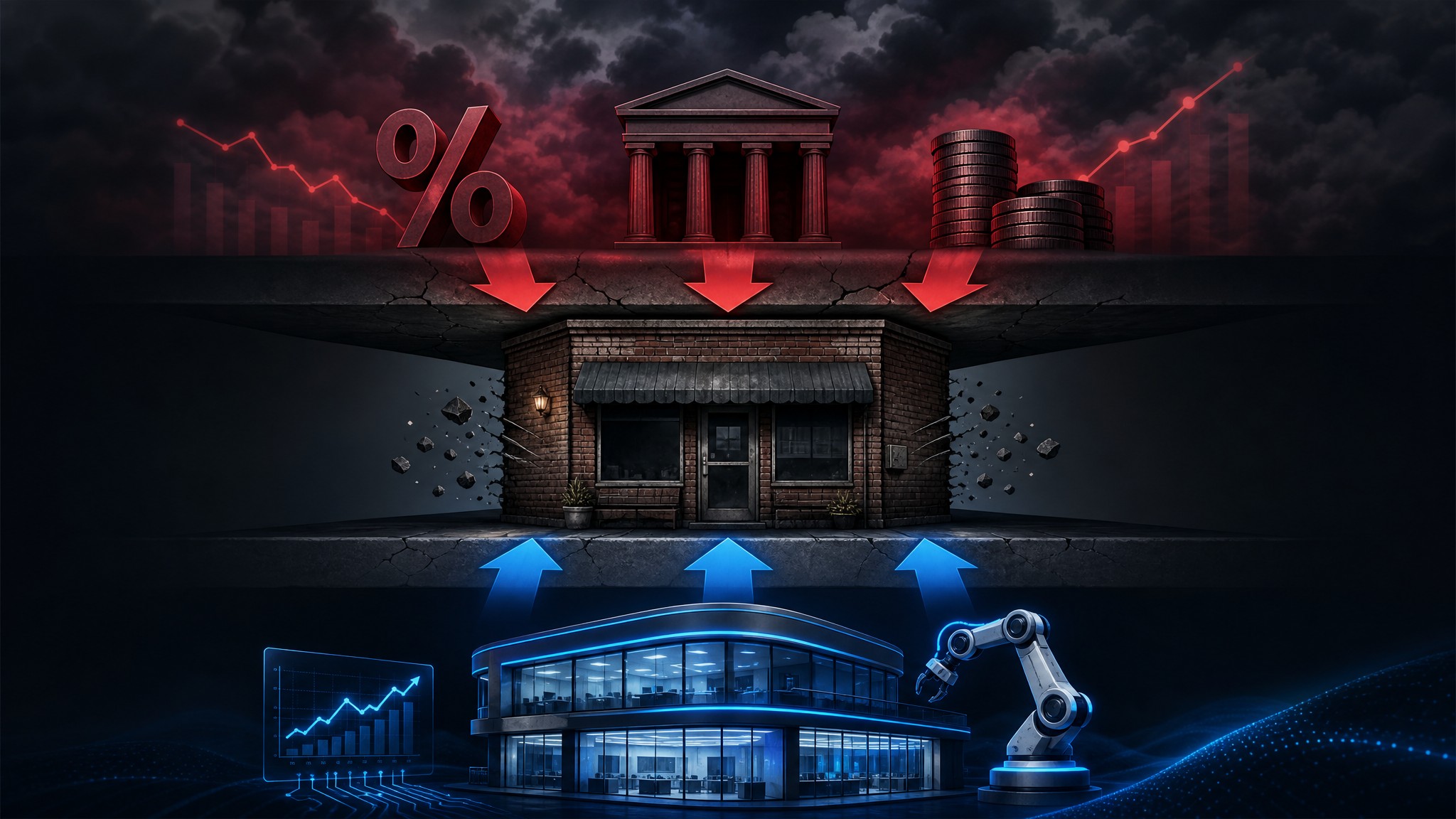
This isn’t a technology problem. It’s a survival problem. And it’s the same dynamic I described in System of Action vs. System of Intelligence: the shift from systems that report to systems that act isn’t coming. It’s here. The only question is whether you’re building one or still reading dashboards.
The Framing Problem
Most business owners don’t think about it this way. They think about AI the way they thought about cloud computing in 2012: “Interesting, probably useful, I’ll look into it when I have time.” They’re framing it as a software decision. Buy a tool or don’t buy a tool. New budget category. Discretionary spend.
That framing is wrong, and it’s going to cost them their business.
AI isn’t software. It’s a hire. When you adopt AI in your operations, you’re not buying a platform. You’re bringing on a team member who works 24/7, never calls in sick, never takes a lunch break, and costs a fraction of what you’d pay a human for the same output. The business owners who get this don’t ask “what software should I buy?” They ask “what role do I need to fill?”
The pricing conversation changes completely when you frame it as a hire. $1,500 a month for a software platform sounds expensive. $1,500 a month for a full-time employee who handles follow-ups, scheduling, client intake, and never misses a lead sounds like the bargain of the century. Same number. Different brain. The first one gets deferred. The second one gets signed.
The Accountability Layer
Here’s the objection I hear most: “I can’t trust AI with my clients.”
Good. You shouldn’t. Not unsupervised.
A bad tax filing can cost a client tens of thousands of dollars. A bad FDA submission can cost a billion in opportunity. AI agents have nothing to lose. No license. No liability. No reputation. No seat on the plane. The autopilot flies the aircraft, but there’s still a pilot in every cockpit. Not because the autopilot can’t fly. Because the pilot has a license to lose.
The model isn’t to replace your experts with AI. The model is to sell the capabilities of an AI agent behind the accountability of a credentialed human. AI does the work. A professional with something to lose signs off on it. The client gets the speed of AI with the trust of human accountability. That’s the product.
A company called Panacea is doing this in life sciences regulatory consulting. They signed $500,000 in contracts in two months. Ninety percent of their seven-figure pipeline is inbound. Their entire model is internal AI platform, expert owns the outcome, fixed-fee pricing instead of hourly. They replaced the incentive to work slowly with the incentive to work fast. The faster they deliver, the bigger their margin, and the happier the client.

That’s not a theory. That’s a business with half a million in signed contracts in sixty days.
I wrote about this dynamic in The Accountability Moat. The argument hasn’t changed: the model is not the moat. Accountability is. But accountability without speed is just liability. AI gives you the speed. The credential gives you the trust. You need both.
What We’ve Learned Running This Model
I run All Lines Business Solutions, an accounting and consulting firm in Florida. We’ve been operating this AI-native model for months. Here’s what we’ve learned that the studies and the threads don’t tell you.
The context is the bottleneck, not the model.
People blame the AI when things go wrong. Nine times out of ten, the AI did exactly what it was told. The problem was that what it was told was incomplete. Every time a human intervenes to fix an agent’s output, you should be asking: what context was missing? Then you write it down, feed it back into the system, and the agent never makes that mistake again. This is how you build compounding leverage. The infrastructure should get smarter with every interaction, not reset to zero.
Agents aren’t aggressive enough by default.
“If something unexpected happens, message me” is a losing strategy. It means you’re betting against the model’s ability to handle edge cases, and the model will always find edge cases you didn’t think of. The better approach is to give the agent a clear, narrow role, let it run, and review the output. Specialized agents beat general ones. An agent that does one thing well is worth more than an agent that does ten things adequately.
Persistent environments are the unglamorous moat.
Agents die. Timeouts, random errors, tasks that lose relevance, failures that don’t self-heal. The difference between a toy demo and a production system is reliability. We run four machines across three locations, with heartbeat checks, memory systems, and failover protocols. It’s not sexy. It’s the difference between an AI that works and an AI that impresses you once and then stops.
You need to own your context.
If your entire AI operation runs on someone else’s cloud, through someone else’s API, stored in someone else’s database, you don’t own your business. You’re renting it. If Anthropic changes their pricing tomorrow, or OpenAI goes down, or your SaaS provider pivots, you lose everything. The businesses that survive the next decade will own their context: their data, their agent configurations, their memory systems, their infrastructure. Not in the cloud. On hardware they control.
The Window
Mary Meeker’s annual report shows AI job postings up 448 percent. Non-AI tech jobs down 9 percent in the same period. The market is already repricing labor. It’s already repricing capital. The businesses that adopt AI in the next 12 to 24 months will have the cost advantage when the squeeze hits full force. The ones that wait will be the ones getting squeezed.
Here’s the math in one sentence: if your competitor adopts AI and you don’t, they double per-person output, cut operating costs by 30 to 40 percent, widen their margins, get better financing terms, and underbid you on every job. You don’t lose because they’re smarter. You lose because they moved first and you didn’t.
The Harvard study proved one person with AI matches a two-person team. The ARK thesis proved AI is repricing the cost of capital for everyone. Panacea proved the business model works. We’ve proven you can run it for small business clients in accounting, tax, and operations.
The question isn’t whether AI will change your industry. That’s settled. The question is whether you’re the one who adopted early enough to benefit from the change, or the one who waited too long and got eaten by someone who didn’t.
The cost of waiting isn’t zero anymore. It’s the most expensive line item on your P&L that doesn’t show up yet. But it will.
Franklin Bryant IV is COO of All Lines Business Solutions and a leading voice in practical AI implementation for small business. He is the creator of the AIIO Assessment framework, a structured evaluation that identifies automation opportunities and quantifies ROI before a single dollar is spent, and SENTINEL, a comprehensive AI security audit for agent infrastructure. He’s currently pursuing his Enrolled Agent credential. Learn more at franklin.simplifyingbusinesses.com.